The AI Agent Configuration Playbook
How to configure and deploy AI agents without writing code—just select, configure, and connect
Contents
Executive Overview
Clinical trials are becoming continuous, sensor-rich, and always-on. That's exciting—and brutal. The volume of signals is exploding while site bandwidth, subject attention, and data quality are still constrained by human workflows.
The winning play is a safety-first agent layer that sits between subjects, sensors, and your trial systems—collecting better data, reducing operational burden, and mediating risk in real time, 24/7. Your competitors are already moving in this direction. The only real choice is whether you buy a generic "everyone-platform" and live inside its constraints, or build proprietary agents that match your protocol, population, endpoints, and risk model—so the system becomes a durable asset, not another vendor dependency.
We work with your team to build the second option.
One critical way we mitigate risk is to architect the system with a human circuit breaker from the beginning. Every AI agent operates within governed boundaries, and when conditions fall outside those boundaries—or when an escalation is triggered—control transfers to human clinical staff. This isn't planning for failure; it's architecting for human invention. In regulated industries like healthcare, this distinction is essential. The system augments human decision-making, but never replaces it. Your clinical team remains the ultimate decision authority, and the architecture ensures that moment of human judgment is preserved, auditable, and designed into every workflow from day one.
We've engineered AI agents in demanding clinical conditions—real-time seizure event detection, sensor-driven behavioral guidance, and safety escalation under strict guardrails—and we've turned those lessons into a configurable framework you can own. We don't sell you a pre-packaged "module." We partner with you to design and build your agents: protocol-specific, compliant by design, fully auditable, and integrated into your data stack.
We build with a workflow-centric methodology that starts from real-world trial workflows—not from technology features. We design for every stakeholder who has to live with the system day to day: research coordinators and CRAs managing operations, principal investigators guiding clinical oversight, and IRB/regulatory teams focused on compliance and trial integrity.
We begin with deep discovery—how work actually gets done, where friction and risk appear, what data must be captured, and what decisions need better support. From that, we craft intuitive experiences and intelligent workflow support that reduce administrative burden, improve data quality, and make adoption feel like relief—not another tool to tolerate.
Only after the user experience is mapped, prototyped, and validated do we lock the technical architecture and implementation plan. That sequence keeps clinical goals in the driver's seat and makes technology the enabler—so teams don't just "use" the system, they recognize it as built for them and celebrate the adoption.
Build vs. Buy: The Economics Have Flipped
Generic SaaS platforms lock you into vendor constraints and inflexible workflows. Custom development, powered by modern AI tooling, is now faster, cheaper, and infinitely more powerful. When you build your own agents, you own the IP, control every safety rule, and evolve the system as AI capabilities advance. You're architecting for the future, not adapting to vendor roadmaps.
Timeline: 6–8 months from kickoff to production deployment, with regulatory and validation workstreams running in parallel so nothing surprises you at go-live.
Why Us
- ⚡
Real-Time Safety & Escalation (Edge + Cloud)
We've built systems that monitor physiological and behavioral signals continuously, detect anomalies, and trigger structured, rules-governed escalation—without drifting into autonomous clinical decision-making. The agent's job is to capture context, verify events, and route risk to the right human workflow.
- 🧠
Turning Raw Signals Into Clinical-Grade Context
Sensors don't produce insight; they produce noise with occasional meaning. We know how to translate device streams into structured, trial-relevant context: symptom timing, triggers, medication adherence clues, cognitive/affective signals, and "what was happening when" metadata that makes downstream analysis far more trustworthy.
- 🛡️
Guardrails That Keep You in Control
Every agent operates inside explicit clinical boundaries:
- • Threshold and trend detection
- • Protocol-specific question flows
- • Keyword / intent escalation
- • Pattern flagging and structured summaries
- • Complete audit trails (what happened, why, and what was sent)
As AI improves, your system gets smarter without becoming more autonomous. Control stays with you.
How We Partner: Advise → Enable → Validate → Scale
Your team builds and owns the system. We bring the expertise, patterns, and frameworks to ensure you build it right—faster, safer, and with fewer costly mistakes.
Advise
We work alongside your team to translate clinical intent into agent architecture. We help you answer the hard questions before your engineers write a single line:
- • What data actually drives decisions—and what's noise?
- • What constitutes a safety signal vs. expected variance for your population?
- • Where are your non-negotiable rules, escalation pathways, and documentation requirements?
- • What does "good data" look like for your specific endpoints?
Enable
Your engineers build. We guide. We provide the battle-tested patterns, reference architecture, and decision frameworks your team needs to build with confidence—without reinventing what we've already solved in high-stakes clinical environments:
- • Conversational flow design (structure, branching, failure modes)
- • Sensor and device integration patterns (real-time ingestion, validation, missingness handling)
- • Longitudinal memory architecture and context stitching across visits
- • Intervention and escalation logic (rules-based vs. model-assisted, human handoff design)
- • Structured output schemas for downstream review and analytics
Validate
We review what your team builds against clinical, safety, and regulatory requirements—before it reaches subjects. We bring an independent expert eye to the things that matter most:
- • Data flow traceability and audit-readiness (EDC / ePRO / eCOA / CTMS connections)
- • Escalation pathway completeness and edge-case coverage
- • Immutable logging and governance controls
- • IRB-facing documentation and SOP alignment support
Scale
We help you move from pilot to production without the missteps that derail regulated rollouts. Your team runs the deployment—we advise on how to make it stick:
- • Pilot design and controlled expansion strategy
- • Failure mode identification and rollback planning
- • Staff training frameworks and operational readiness
- • Ongoing monitoring criteria and configuration governance
Train
CROs and trial teams are experts at preparing studies for launch—defining protocols, configuring ePRO systems, setting up data capture rules, mapping workflows. AI agent configuration is a new layer of that same preparation. We train your staff to own it:
- • How to translate a protocol into agent configuration: thresholds, branching logic, escalation pathways, and safety rules
- • How to define and manage AI prompts, lexicons, and knowledge collections for each study population
- • How to configure intervention logic and test it before subjects ever see it
- • How to stand up a new agent for a new trial—without starting from scratch each time
- • How to review, audit, and update configurations as protocols evolve
The goal: your team can spin up a study-ready AI agent the same way they configure an EDC today—methodically, confidently, and without needing outside help.
What You Own
- 🔒 Proprietary AgentsBuilt for your protocol and population. You own the IP, workflows, prompt assets, and integration logic—no licensing traps.
- ⚙️ Purpose-Built ArchitectureDesigned around your endpoints, safety model, and operational reality—not a generic platform you contort into place.
- 📊 Better Data, Faster Response24/7 monitoring, real-time escalation, richer context, fewer missed signals, less subject drop-off, and less site burden.
- 🚀 Future-Proof SystemA framework that can absorb new AI capabilities over time while keeping guardrails and governance intact.
- ⏱️ Fast to Launch6–8 months to production, with regulatory planning alongside build—so deployment is a controlled transition, not a cliff.
- 🧠 The Capability to Build On DemandYour team owns the knowledge and frameworks to configure AI agents for any new study, any new sponsor, any new population—on your own timeline, without external dependencies. That institutional capability becomes yours to keep, refine, and compound across every future trial.
🤖 An Expandable Agent Architecture
We train your team on the two foundational agent types: the study-facing agent that conducts subject interactions, and the intervention agent that monitors it in real time. But the framework is designed to grow. As AI agents become more reliable and your team becomes more confident operating them, new agent types can be layered in—each handling discrete, well-defined tasks with minimal human involvement beyond an approval step. Examples already within reach:
- • A device logistics agent that receives a replacement signal from the device support agent—once troubleshooting has been exhausted—and handles the fulfillment side: initiating the replacement order and coordinating shipping to the subject, without requiring site staff involvement
- • An eligibility screening agent that reviews incoming referrals against protocol inclusion/exclusion criteria and surfaces only borderline cases to a coordinator for final review
- • A protocol deviation detection agent that flags missed visits, incomplete assessments, or out-of-window data in real time—before they become findings in an audit
- • A data reconciliation agent that cross-checks subject-reported data against sensor readings and EMR feeds, surfacing discrepancies for clinical review
The architecture you own is not a fixed product—it's a composable framework. Each new agent type you add extends your operational leverage without requiring you to rebuild from scratch.
Part 1: How It Works – The Three-Layer System
The Architecture
For DCT platforms serving CROs and sponsors, the goal isn't "one agent for one trial." The goal is to add a governed AI agent layer your platform can deploy across many studies—adaptable per protocol, but consistent in safety, auditability, and operational control.
We build this as a three-layer architecture. Nothing here is "pre-built and handed to you." What we bring is the battle-tested blueprint—the patterns that actually work in regulated, real-time environments—then we conceive, design, and build the platform-grade agent layer inside your product.
Layer 1: The Agent Foundation (Platform-Grade Core)
This is the core engine your platform has been missing: the capability to run safe, context-aware subject interactions continuously, while ingesting signals and routing risk.
Key capabilities we implement at the platform level:
- • Multi-turn conversational orchestration (structured flows, branching logic)
- • Real-time signal ingestion (sensor + subject-reported + system events)
- • Trigger detection (thresholds, trends, keywords, patterns)
- • Governed escalation and routing (human-in-the-loop by design)
- • Audit logging and traceability (who/what/why/when)
Think of this as the agent operating system your platform can reuse across studies.
Layer 2: Study & Sponsor Configuration (Controlled Flexibility at Scale)
Your platform must support many studies without custom code every time. This layer is the configuration plane that allows controlled variation:
- • Protocol-specific thresholds, schedules, and escalation pathways
- • Study-specific questionnaires and branching flows
- • Role-based routing (site staff vs sponsor medical monitor vs safety desk)
- • Language/tone options and population-specific vocabularies
- • Permissions, governance, and change control
This is where CROs and sponsors can tailor behavior without breaking compliance and without creating a maintenance nightmare.
Layer 3: Integration & Data Fabric (Your Platform's Systems, Unified)
This layer connects the agent foundation to the platform's existing ecosystem:
- • Device/sensor feeds (CGM, wearables, vitals devices, custom integrations)
- • EDC/ePRO/eCOA/CTMS connectors (as your platform supports)
- • Data lake/warehouse pipelines for analytics and oversight
- • Event schemas + audit trails that hold up under scrutiny
- • Bidirectional workflows where appropriate (tasks, flags, queries, notes)
The agent doesn't become "another tool." It becomes a native capability of your platform.
Result
Your platform gains a new category of capability: always-on, governed AI agents that increase subject engagement, improve data completeness, detect safety signals faster, and reduce site burden—while preserving sponsor and CRO control, traceability, and compliance.
What We Bring (Not "Pre-Built Modules")
We're not selling a generic agent widget. We're bringing proven, high-stakes experience and rebuilding it as a platform capability your customers can deploy repeatedly.
Signal Handling Layer
Ingests CGM/vitals/wearables + self-report + platform events, aligns timelines, validates inputs, flags anomalies.
Conversation + Workflow Orchestrator
Runs protocol-driven dialogues, follow-ups, education, structured capture, and exception handling.
Trigger & Pattern Detection
Thresholds, trends, adherence patterns, safety keywords, and "risk clusters" defined per study.
Escalation & Routing Engine
Routes to the right humans with context (site, CRA, medical monitor, safety team), with configurable pathways and SLAs.
Subject Interaction Layer
Mobile-first, low-friction experiences that improve compliance and reduce dropout.
Operational Visibility
Dashboards and reporting for engagement, missed check-ins, escalations, resolution time, and data quality.
(These aren't "features you toggle on." They are foundational capabilities built in a governed, auditable way.)
Platform Configuration Essentials (What Your Customers Control Safely)
Every platform-grade agent layer needs four configurable planes:
1) Use-Case Library (Deployable Agent Types)
Not "templates" in the shallow sense—deployable agent archetypes your platform can support:
- • Daily check-ins
- • Symptom monitoring
- • Device troubleshooting
- • Adherence support
- • Post-event structured capture
- • Safety triage and routing
2) Data Inputs (Sensors + Self-Report + System Events)
Connectors and ingestion rules: what data comes in, cadence, validation rules, and how missingness is handled.
3) Safety & Behavior Rules (Governed + Auditable)
Thresholds, trend logic, escalation keywords, routing, documentation rules, and change control.
4) Personalization (Population Fit Without Chaos)
Tone, reading level, language, frequency, and optional voice—bounded by governance.
Typical Platform Timeline
- Discovery + product/ops mapping: 4–6 weeks
- Foundation build (agent core + configuration plane): 8–12 weeks
- Integration + pilot customers/studies: 8–12 weeks
- Validation hardening + scale readiness: 4–8 weeks
In practice: 6–8 months to a production-ready, platform-embedded agent layer with early pilots along the way.
Part 2: Configuration Essentials
Every AI agent starts with these four configuration decisions:
Agent Template
Select the primary purpose: Daily check-in? Symptom monitoring? Device troubleshooting? Medication adherence? Each template comes with pre-tuned prompts and rules.
Examples: Daily Glucose Monitor, Symptom Alert Agent, Device Support Agent, Medication Reminder Agent
Data Configuration
Connect your data sources. Point to your glucose data, weight scales, BP monitors, activity trackers, and custom databases. The system automatically pulls real-time data.
Examples: Sensor API endpoint, EHR connection, cloud database, manual entry fields for subjects to add data
Behavior Rules
Set thresholds and escalation logic. Define what triggers conversations ("glucose > 300"), what escalates ("chest pain" keyword), and when to offer support.
Examples: If glucose > 280, suggest hydration. If glucose < 70 and no recent food log, escalate to RN. If "emergency" mentioned, immediate page.
Personalization
Choose the tone, vocabulary, and interaction style. Match your population and clinical guidelines. Select voice options if using voice interactions.
Examples: Formal/casual tone, medical terms vs. plain language, male/female voice, frequency of check-ins
Configuration Timeline
Most configurations take 1-2 weeks: Kick-off meeting (who, what, why), data integration setup, behavior rules definition, testing with pilot cohort, final adjustments, full deployment.
Part 3: Agent Types & Templates
Each agent type comes pre-built with default prompts, rules, and workflows. Configure them to your needs:
Daily Check-in Agent
Symptom Alert Agent
Device Support Agent
Medication Adherence Agent
Data Collection Agent
Part 4: Setting Up Your Data
Your AI agents need three main types of data: sensor data (device readings), knowledge data (protocols, lexicons, guidance), and longitudinal memory (tracking context over time).
Sensor & Device Data
- Dexcom G7 CGM → Real-time glucose data
- Withings scale → Daily weight logs
- Omron BP monitor → Blood pressure readings
- Fitbit → Activity and sleep data
Protocol & Knowledge Collections
- Study protocol inclusion/exclusion criteria
- Hypoglycemia management guidelines
- CGM sensor replacement instructions
- Medication side effect information
Longitudinal Memory
- Medication Adherence Tracking: Monitors whether subjects confirm taking prescribed medications. AI knows exactly which doses were taken/missed without asking them to recall. Escalates if 2+ consecutive misses detected.
- Symptom Progression Monitoring: Tracks reported symptoms (pain, fatigue, nausea) and severity trends over 7-30 day windows. AI detects worsening patterns early: "Your pain scores increased from 3→6 over the past week."
- Conversation Continuity: Recalls prior discussion topics, promises made, and follow-up actions. "Last time we talked about your new exercise routine—how did that go?" Subjects feel heard and valued.
- Lifestyle Pattern Recognition: Identifies correlations between behaviors (sleep, meals, exercise) and health outcomes (glucose, mood, energy). "I noticed your glucose is more stable on days when you log breakfast before 9am."
AI/ML Insights: The Value Multiplier
- Per Subject Intelligence: ML builds personalized behavioral models for each individual. Predicts when a subject is likely to miss medication based on sleep patterns, stress indicators, and prior adherence cycles. Recommends optimal check-in times based on their engagement history. Identifies early warning signs of dropout risk—decreased response rates, changes in interaction patterns—before clinical team notices.
- Across Study Optimization: Aggregates data from all subjects to identify population-level patterns. Discovers that subjects who receive encouraging messages after logging good glucose readings have 40% better long-term adherence. Detects that symptom reports decline on weekends (engagement fatigue?) and adjusts check-in frequency accordingly. Learns which educational content actually changes behavior vs. what subjects ignore.
- Cross-Study Learning: Compares longitudinal memory patterns across different trials to identify best practices. Learns that certain intervention sequences work better for Type 2 diabetes subjects over age 65. Discovers protocol variations that yield 30% better data completeness. Builds a knowledge base that makes each new trial smarter than the last.
- Real-Time Contextualization: When a subject reports feeling "tired," ML instantly contextualizes: Is this their normal post-lunch pattern? A new symptom requiring escalation? Related to last week's medication change? The AI provides this context to clinical staff in real-time—transforming isolated data points into actionable clinical intelligence.
AI Prompts
- Alert Prompt: "Your glucose is 320 mg/dL. Have you checked your insulin pump? When did you last eat? Let's review your correction dose protocol."
- Intake Prompt: "Welcome! I'll be checking in with you daily to monitor your diabetes management. First, let's confirm your current medications and dosing schedule."
- Education Prompt: "High glucose can be caused by missed medications, carb-heavy meals, illness, or stress. Let's identify what might have triggered this reading."
- Safety Prompt: "I'm concerned about the symptoms you mentioned. On a scale of 1-10, how severe is your chest pain? Are you experiencing shortness of breath or sweating?"
Interventions
- Threshold Intervention: If glucose > 300 mg/dL for 2+ hours → Send hydration guidance, check for ketones, escalate to diabetes educator
- Keyword Intervention: If subject mentions "chest pain" or "can't breathe" → Immediate escalation to clinical staff with full context and subject contact info
- Data Gap Intervention: If no glucose readings for 24 hours → Check device status, troubleshoot connectivity, offer replacement if sensor failed
- Compliance Intervention: If 3+ missed medication doses in 7 days → Adherence counseling conversation, identify barriers, potentially escalate to coordinator
Lexicon Sets
- Symptom Lexicon: "Nauseated" = mild nausea, "vomiting" = severe nausea requiring intervention, "queasy" = early warning sign
- Emotional Lexicon: "Frustrated" = manageable distress, "hopeless" = concerning depression indicator, "can't go on" = crisis language requiring immediate assessment
- Medical Terminology: "High sugar" = hyperglycemia, "low" = hypoglycemia, "shaky" = hypoglycemic symptom requiring glucose check
- Device Language: "Not working" could mean: sensor fallen off, app won't sync, readings seem wrong, device error message—AI asks clarifying questions based on lexicon
LLM Options
- Daily Check-in: Fast, cost-efficient model for routine "How are you feeling?" conversations
- Symptom Assessment: Advanced reasoning model for interpreting complex symptom combinations and severity
- Safety Evaluation: Highest-capability model for suicidal ideation screening, crisis assessment, medical emergency triage
- Educational Content: Mid-tier model with strong explanation abilities for teaching subjects about their condition
Voice Options
- Elderly Population: Slower pacing, clearer enunciation, confirmation of heard responses before proceeding
- Accessibility: Voice-first interface for subjects with vision impairment or limited dexterity
- Hands-Free Scenarios: Enable voice during activities (cooking, exercising) when typing is inconvenient
- Multilingual: Voice recognition for non-English speakers in their native language
Interactive Buttons
- Medication Confirmation: Buttons for "Took morning dose," "Took evening dose," "Missed dose (forgot)," "Missed dose (side effects)"
- Symptom Logging: Quick buttons for common symptoms: "Headache," "Nausea," "Fatigue," "Pain"—each opens targeted follow-up questions
- Device Issues: "Sensor fell off," "App won't sync," "Need replacement," "Getting error message"—routes to appropriate troubleshooting
- Urgent Actions: "Talk to nurse now," "Having emergency," "Need medication refill," "Schedule visit"
Data Privacy & Security
All data connections are encrypted. The agent doesn't store subject data—it reads, analyzes, and triggers actions. Your data stays in your systems. Longitudinal memory extracts patterns and insights but references back to source data rather than duplicating it.
Part 5: Safety & Escalation Rules
Safety is built in. You just define the rules that matter to your trial:
Threshold-Based Escalation
Example: If glucose > 300 mg/dL for 2+ consecutive readings, page the diabetes educator
You set: the threshold value, number of triggers, time window, and who gets notified
Keyword-Based Escalation
Example: If subject mentions "chest pain" or "difficulty breathing," immediately escalate to RN with SMS alert
You set: keywords to monitor, confidence thresholds, escalation urgency, and recipients
Pattern-Based Escalation
Example: If glucose readings are trending upward for 5+ days, suggest medication review call
You set: the pattern rule, trigger conditions, and what action the agent takes
Engagement-Based Escalation
Example: If subject hasn't responded in 48 hours, escalate to research coordinator for re-engagement call
You set: non-response time, escalation action, and retry frequency
How Escalation Works
Agent detects trigger → Pulls full context (data, conversation history) → Pages/emails designated staff → Staff sees dashboardwith all info → Staff takes action → Outcome logged. Total time: <2 minutes.
Part 6: Cost & Efficiency ROI
Traditional Approach (200 Subjects, 12 Weeks)
- 200 subjects × 1 call/week × 12 weeks = 2,400 calls
- Per-subject call: $25-40 (nursing/RA time)
- Total cost: $60K-96K in staff time
With AI Agent System (200 Subjects, 12 Weeks)
- AI-Handled Contacts: 200 subjects × 9 contacts/week × 12 weeks = 21,600 total AI interactions
- Escalations: ~25% of subjects (50) require escalation
- 50 subjects × 3 escalations each = 150 escalations total
- 150 escalations × $25-40 per escalation = $3.8K-6K staff time
- Total cost: $3.8K-6K (staff) + minimal AI infrastructure
12-Week Trial Savings (200 Subjects)
$54K-90K
90%+ cost reduction while enabling 18x more clinical touchpoints (9 AI contacts/week vs. 1 human call/week) and focusing staff on only the 25% of subjects needing escalation.
Beyond Cost: Non-Monetary Benefits
- ✓ 24/7 subject support (no off-hours gaps)
- ✓ Earlier detection of safety issues
- ✓ Higher data quality (AI prompts for missing info)
- ✓ Longitudinal memory tracks context over time—AI knows each subject's history, medication adherence patterns, symptom trends, and conversation continuity without subjects repeating themselves
- ✓ Faster, more timely engagement—responsive and personalized in the moment, with AI responses that know their complete record
- ✓ Subjects prefer chatting over phone calls (higher satisfaction, lower attrition)
- ✓ Device failure detection with AI testing and replacement coordination
- ✓ Rich contextualized data (self-reported outcomes synced with sensor data for complete clinical picture)
- ✓ Multilingual support—agents configured to speak directly in any of 99+ languages, built natively in the subject's language without translation layers
- ✓ Staff morale improvement (less routine calling, more clinical decision-making)
Voice Interaction Option
Voice LLMs enable subjects to speak naturally with the AI agent rather than typing. This significantly improves accessibility and engagement, particularly for elderly subjects or those with mobility limitations.
Additional Cost: Voice LLMs cost 3-5x more than text-based interactions due to real-time speech processing and natural language synthesis.
Our Recommendation: Begin with text-based agents to establish operational stability, gather user feedback, and validate clinical workflows. After 6+ months of successful operation, selectively enable voice for cohorts where it provides the greatest benefit—typically older populations or subjects with motor difficulties.
This phased approach balances cost efficiency with accessibility needs and allows your team to master the system before introducing more complex interaction modalities.
Part 7: Real-World Use Cases
Type 2 Diabetes Trial
Heart Failure Remote Monitoring
Oncology Quality-of-Life Study
COPD Exacerbation Prevention
Part 8: Unified Agent Architecture
The system uses a streamlined, purpose-built design with two seamlessly integrated agent types:
Primary Task-Driven Agent
Handles the primary workflow: daily monitoring, data collection, symptom assessment, medication reminders, or device support. This agent maintains conversational context, asks clarifying questions, provides education, and collects structured data within your configured parameters.
Always active, always listening for escalation triggers while completing its assigned task.
Intervention Agent
Activated when escalation thresholds are met. Provides crisis support, de-escalation, safety assessment, or specialized guidance (e.g., "breathing coach" for anxiety, "safety assessment" for suicidal ideation). Then seamlessly returns the conversation to the primary task or routes to human staff.
Appears contextually based on detected conditions—never interrupts unless needed.
Seamless Conversation Continuity
Unlike systems that "hand off" between agents, our architecture maintains a single conversational thread. When an intervention trigger is detected, the intervention agent responds to the immediate concern while maintaining full context of the primary task. Once the concern is addressed, the conversation flows back to the primary agent—the subject never perceives agent switching.
This unified approach eliminates confusion, maintains engagement, and ensures clinical safety without technical complexity.
Why No Multi-Agent Orchestration
Complex systems with multiple agents, hand-offs, and decision trees are harder to control, debug, and audit. Our architecture deliberately avoids this complexity. One primary task agent + one intervention agent = clinical clarity, safety, and operational efficiency. You always know what the agent will do and why.
Part 9: Deployment & Distribution
Deployment in a regulated clinical environment requires careful planning, validation, and compliance review:
Requirements & Regulatory Planning
Map agent system to trial protocol. Identify regulatory touchpoints (IRB, sponsor approval). Define data handling and audit requirements. Document compliance approach.
Existing System Integration
Your IT/engineering team integrates the agent platform with your existing sensor infrastructure, EHR, and data systems. APIs are configured for real-time data ingestion and bidirectional data flow.
Data Architecture & Security Validation
Validate end-to-end data flow: sensors → agent system → conversations → data back to your platform. Security testing, encryption, audit logging, and data integrity checks.
Configuration & Testing
Configure agent templates, thresholds, prompts, and escalation rules. Comprehensive testing including edge cases, data validation, and escalation workflows.
Pilot Cohort with Regulatory Oversight
Deploy to 10-20 subjects for 4-6 weeks. Monitor all interactions, escalations, data flows. Collect detailed feedback. Document outcomes for regulatory submission.
Regulatory Documentation & Approval
Prepare amendment submission for IRB/sponsor including: system design, data handling procedures, safety protocols, pilot results, validation testing summary.
Staff Training & Standard Operating Procedures
Develop SOPs for escalation response, data handling, system troubleshooting. Train all clinical and operations staff. Document training completion.
Full Enrollment & Launch
Send enrollment materials to subjects. Confirm data integration stable. Activate agent system across full cohort.
Ongoing Monitoring & Compliance
Real-time dashboards for escalations, data quality, agent performance. Weekly team review. Quarterly regulatory reporting. Adjust configurations based on data.
Data Bidirectional Integration
Agent reads real-time sensor data from your existing systems. Conversations, escalations, and outcomes are logged back to your trial database for regulatory compliance and analysis.
Audit & Compliance
Complete audit trail of all AI interactions, data accessed, escalations triggered, and staff actions. Designed to meet FDA, IRB, and HIPAA requirements.
Deployment Timeline (6-8 Months)
With parallel workstreams: architecture + regulatory planning overlap; development + security testing overlap; pilot + documentation overlap
6-8 months start to full deployment
Achievable with: parallel development streams, pre-engagement with regulators, experienced engineering team, and clear requirements from day one.
Part 10: Technical Architecture
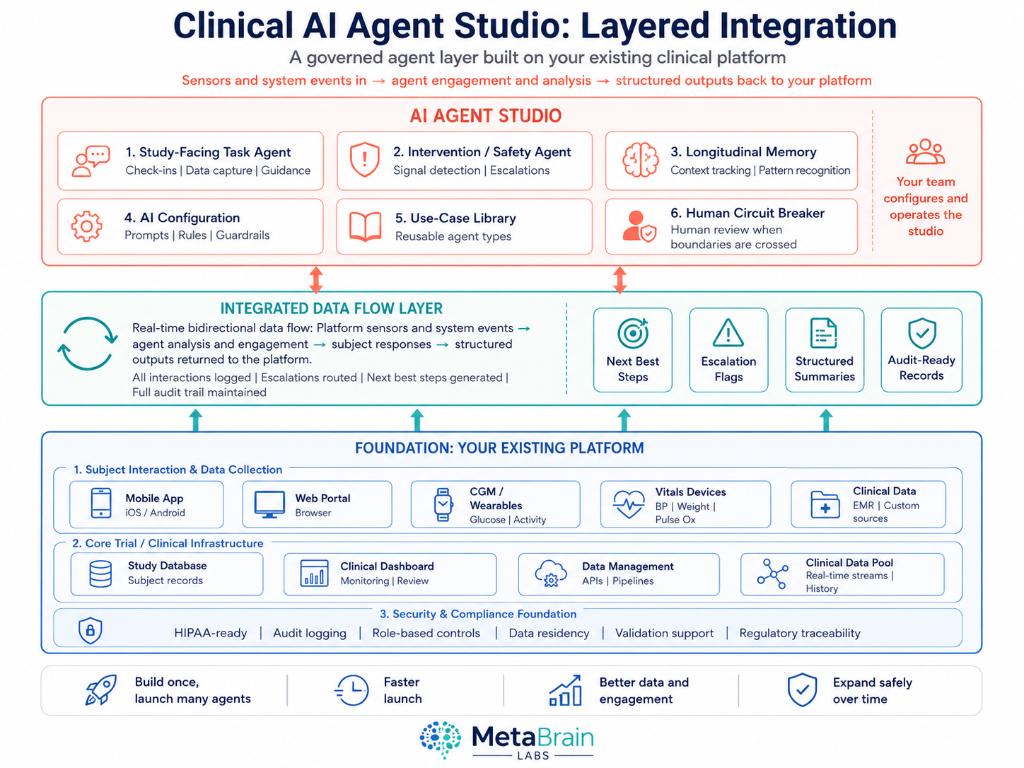
Your existing clinical trial platform with AI agents integrated as a new intelligent interaction layer—a governed agent layer that sits on top of your sensors, systems, and workflows. But here's what makes this different from buying a generic platform: we help you build your own AI Agent Studio. Not a licensed module you live inside—your studio, with your protocols, your prompts, your safety rules, your lexicons, and your agent library. Your team configures and operates it. Your engineers own the integration logic. And every agent you build becomes a reusable asset in a library you control, ready to deploy across studies, sponsors, and populations without starting from scratch. The architecture below shows how the studio assembles these components into governed, task-specific agents—and how the outputs flow back into your platform as structured, audit-ready records.
What an Agent Built in the Studio Looks Like
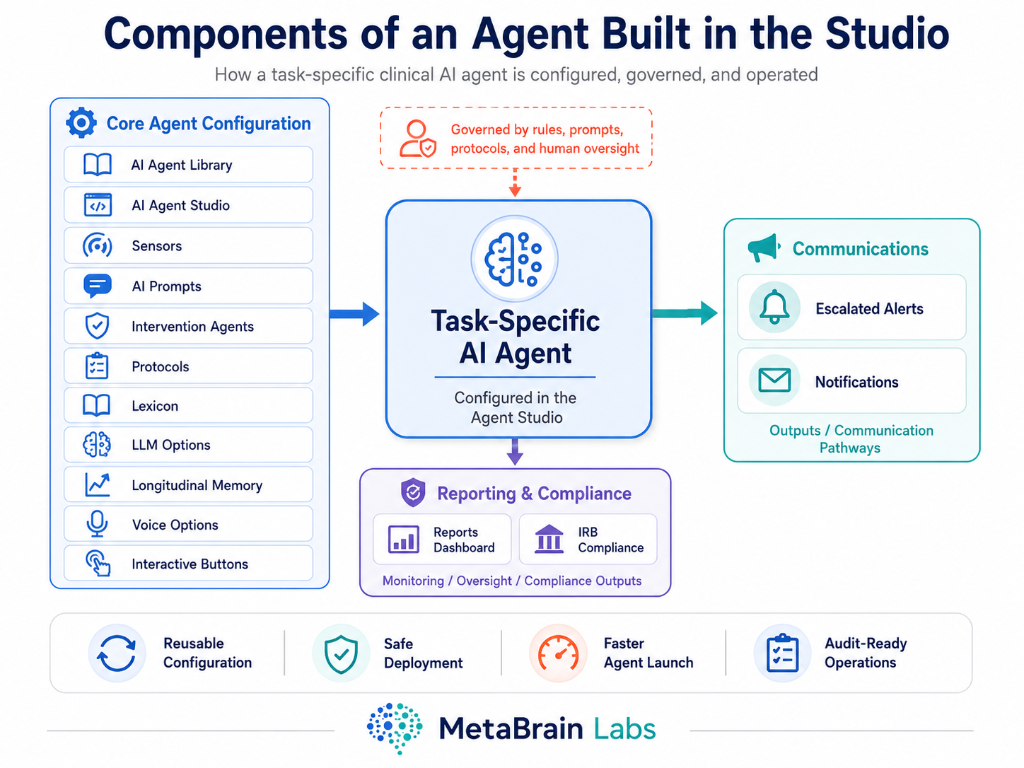
Every agent your team builds in the studio is assembled from a common set of governed components—prompts, sensors, intervention logic, protocols, lexicons, longitudinal memory, LLM routing, voice, and interactive buttons—all wrapped in rules, protocols, and human oversight. The same configurable building blocks compose any task-specific agent, so your team can launch new agents the same way they configure an EDC today. Outputs flow out through communication pathways (escalations, notifications) and into reporting and compliance (dashboards, IRB), with audit-ready records at every step.
Your Existing Platform
Complete clinical trial infrastructure: subject management, sensor integration, data collection, staff tools, and compliance framework. Fully operational and battle-tested.
New AI Layer Integration
AI agents sit above your existing platform, intelligently processing sensor data and subject interactions. All data flows bidirectionally back to your trial database and staff dashboards. No disruption to current workflows.
Part 11: Patent Protection & Your Moat
Our technology isn't only an implementation advantage—it's protected ground. MetaBrain Labs' patent family covers the exact architectural shift reshaping clinical trials: sensor-informed, always-on AI agents that interact with subjects, collect structured context, validate signals, and trigger real-time guidance and escalation inside defined safety boundaries.
What the Patent Family Protects
A system that:
- •Uses a digital agent to conduct structured, adaptive interactions (not just passive data capture)
- •Ingests sensor and device signals during the interaction
- •Applies pattern recognition + reference/baseline evaluation to interpret and validate signals
- •Generates structured outputs, interventions, or escalations based on that evaluation
- •Does all this inside a governed architecture with control rules, safety boundaries, and auditability
Why This Matters for You
When you partner with us, you're not just buying development capacity—you're acquiring:
- A Defensible Architecture:Your trial agents are built on a foundation aligned with a protected system design—creating strategic distance from generic platforms racing to bundle "agentic trials."
- Freedom to Build:As more platforms add AI agents, feature parity becomes inevitable. IP is how you avoid becoming one more customer on someone else's roadmap.
- Leverage in Partnerships:A protected system changes the conversation with CROs, sensor partners, and enterprise buyers. You're building an owned capability with defensible differentiation.
Your Moat: Patent + Implementation + Trade Secrets + Configuration
Your competitive advantage comes from:
- •Patent coverage(core system + continuation expansion for newer agent architectures)
- •Implementation know-how(real-world safety monitoring, escalation, subject engagement)
- •Trade-secret assets(agent libraries, rules/guardrails logic, validation pipelines, audit trail design)
- •Your proprietary configuration(protocol-specific triggers, endpoints, escalation pathways, unique to your organization)
Partner Pricing & Exclusive Licensing Options
When you build with us, we offer strategic IP benefits:
- Partner Pricing on Patent Access:Organizations partnering with us receive preferred pricing on patent licensing as part of your partnership agreement—aligning our IP protection with your implementation success.
- Field-of-Use Exclusivity Options:The patent family supports time-limited, scope-limited exclusive licensing—for example, defined exclusivity around a therapeutic area, trial type, or monitoring modality. This transforms IP from "paper" into a competitive barrier that protects your investment and future market position.
Your Moat Strategy
IP becomes a long-term asset, not a one-time transaction. When we build your agents together, they're built on defensible ground. You own the implementation, the configuration, and leverage the patent family as your strategic moat—either as partner pricing advantage or through exclusive licensing arrangements tailored to your competitive positioning.
Conclusion: You're Building Your Own Internal AI Agents
This isn't about deploying pre-built agents. You're building your own internal AI capabilities—configured specifically for your trial, integrated deeply into your data systems, and controlled entirely by your clinical team. We guide you through every component: architecture, data integration, safety rules, regulations, and deployment. You own the agents.
What You Control
- ✓ Every threshold, rule, and escalation logic
- ✓ How agents interact with subjects (tone, language, frequency)
- ✓ Which sensor data is used and how it's interpreted
- ✓ Where escalations go and how staff responds
- ✓ How conversations tie back to your trial database
- ✓ All audit trails, compliance documentation, and regulatory submissions
The Economics: 12-Week Trial with 200 Subjects
Traditional Approach
$60K-96K
Staff time (1 call/week × 12 weeks)
With Your AI Agents
$3.8K-6K
Staff time (25% escalations only)
Trial Savings: $54K-90K (90%+ reduction)
More Importantly: Exponentially More Touchpoints
Your trial traditionally reaches each subject ~1 time per week via scheduled RA/clinician call.
With AI agents, each subject gets ~9 contacts per week: daily check-ins + symptom assessments + device support + threshold alerts + medication reminders—24/7, responding in real-time.
Workflow difference: Traditional = everyone gets equal time. AI = focus staff on the 25% of subjects who actually need intervention, while 100% still receive excellent monitoring.
Result: 18x more touchpoints. Issues detected days earlier. Staff focus only on escalations. Subjects feel continuously supported, not abandoned between calls.
This is clinical effectiveness. More data. Earlier detection. Better outcomes. All while reducing operational burden on your team by 90%+.
How This Works in Practice
- Your nursing team? Still clinical decision-makers. They see escalations, review AI summaries, and make the calls that matter. But 85% of routine monitoring is handled. Your RN doesn't spend 6 hours/week on repetitive calls—they spend 1 hour on critical interventions.
- Your subjects? Experience continuous support. When glucose spikes at 2am, the agent responds immediately. When they report new symptoms, the agent assesses severity and connects them to staff. When they miss a dose, the agent reminds them—not your coordinator.
- Your trial data? Rich, dense, and timely. Real-time glucose trends, symptom patterns, adherence metrics, escalation events—all flowing back to your database continuously. Your analysis isn't based on weekly check-in snapshots. It's based on complete, unfiltered clinical reality.
You're not buying agents. You're building your own internal AI capability, owned and controlled entirely by your organization. We guide you through every step—architecture, data integration, safety rules, regulatory compliance, pilot validation, and full deployment. Your clinical team makes all decisions. The result is a proprietary AI system built specifically for your trial that runs smarter, faster, and more effectively—while saving you 90%+ of routine operational costs and enabling 18x more clinical touchpoints by focusing staff exclusively on the 25% of subjects requiring escalation.